
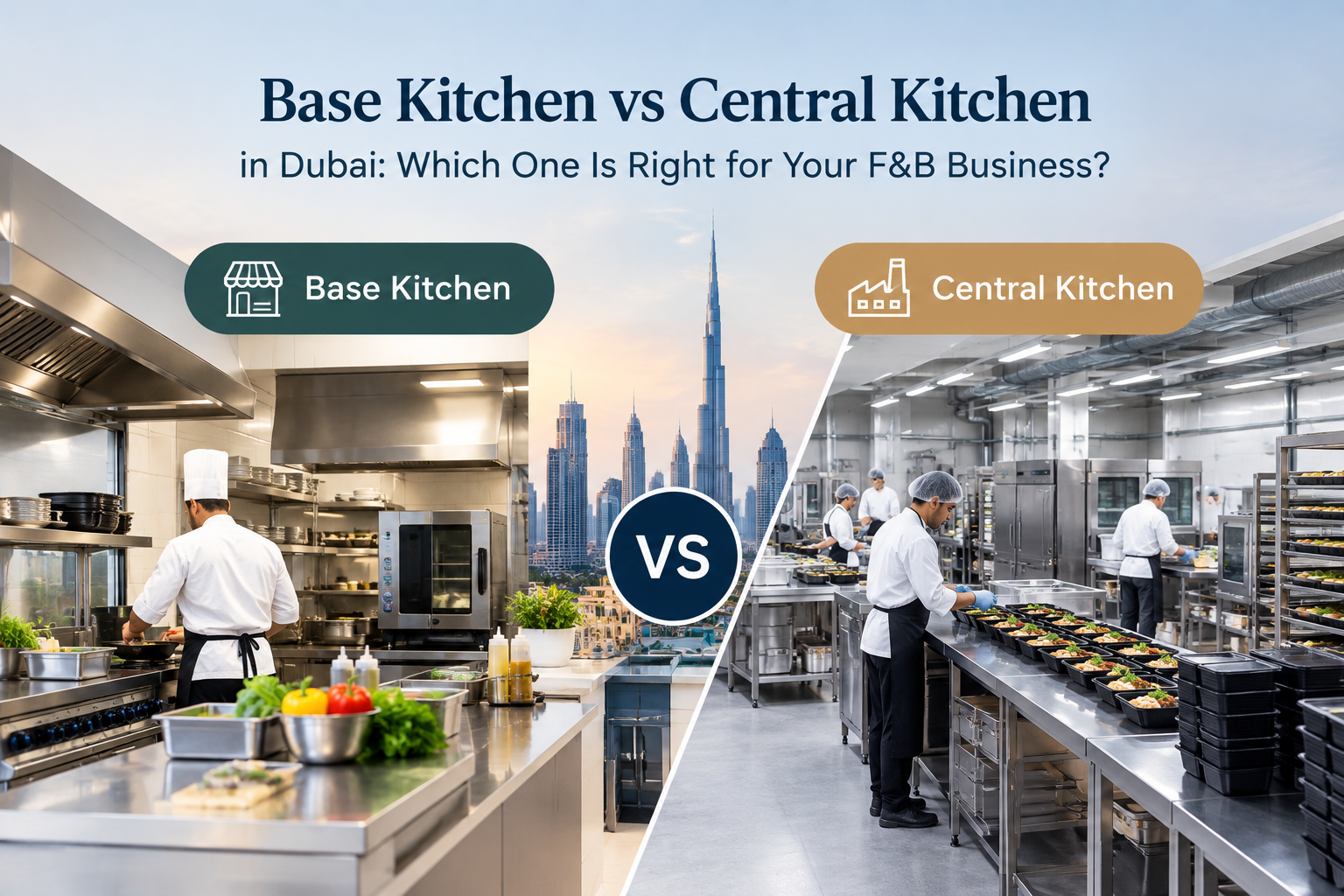
Planning to launch a cloud kitchen, expand your restaurant brand, or supply food to multiple outlets in Dubai? Before investing in a commercial kitchen, you need to decide how your food business will operate. Choosing between a base kitchen and a central kitchen can influence your rental costs, production capacity, delivery operations, and long-term growth.
While both facilities support food preparation, they serve different purposes. A base kitchen can be suitable for a focused food business, whereas a central kitchen is generally designed for larger-scale production and supplying multiple outlets.
So, which option makes more sense for your business? Let’s compare the two and explore what you should consider before leasing a kitchen in Dubai.
What Is a Base Kitchen?
A base kitchen is a dedicated facility for preparing, cooking, storing, and packing food. It typically supports a specific restaurant brand, cloud kitchen, catering business, or delivery-focused operation without requiring a customer-facing dining area.
For entrepreneurs exploring Base Kitchen space in Dubai, this setup can offer a practical way to launch a food concept without investing in a full-service restaurant.
A base kitchen may be right for you if you:
- Are launching a new food or delivery brand.
- Operate a cloud kitchen serving online orders.
- Run a small or medium-sized catering business.
- Need a dedicated space to manage food preparation and dispatch.
The key is finding a facility that matches your menu, expected order volume, equipment needs, and delivery areas.
What Is a Central Kitchen?
A central kitchen is a production facility that prepares food, ingredients, or semi-finished products for distribution to multiple restaurants, cafes, catering locations, or other outlets.
Instead of preparing everything separately at each location, a business can centralise production and distribute prepared items to individual outlets for final preparation or service.
Businesses searching for Central kitchen space in Dubai may benefit from this model when they operate several outlets or need consistent food preparation at scale.
A central kitchen may be right for you if you:
- Manage a restaurant chain or multiple food outlets.
- Supply food to several cafes or franchise locations.
- Handle large catering orders.
- Want to standardise recipes, portions, and production processes across locations.
However, centralising production also requires careful planning for storage, food safety, staffing, transportation, and distribution.
Base Kitchen vs Central Kitchen: What’s the Difference?
Factor | Base Kitchen | Central Kitchen |
Main purpose | Supports a specific food business or delivery operation | Supplies multiple outlets or locations |
Production scale | Depends on the individual business’s demand | Generally designed for larger production volumes |
Space requirements | Based on menu, equipment, and daily orders | Based on bulk production, storage, and distribution |
Typical users | Cloud kitchens, individual brands, catering businesses | Restaurant chains, multi-outlet brands, large caterers |
Cost considerations | Rent, equipment, utilities, and staffing | Production infrastructure, storage, staffing, and logistics |
Best suited for | Starting or operating a focused F&B concept | Scaling production across multiple locations |
Neither option is automatically better. The right choice depends on your current operations, financial capacity, and expansion plans.
4 Factors to Consider Before Leasing a Kitchen in Dubai
1. Your Business Model and Growth Plans
Are you starting with one food brand or planning to supply several outlets? A base kitchen may be sufficient for a single delivery-focused operation. A central kitchen may be more practical when production needs are shared across multiple locations.
Consider your expected order volumes and expansion plans over the next two to three years before choosing a facility.
2. Location and Accessibility
Your kitchen’s location affects supplier access, delivery times, staff commuting, and distribution costs. When evaluating Cloud kitchen space in Dubai, consider proximity to your target delivery areas, major roads, suppliers, and the outlets you intend to serve.
A property with lower rent may not be the most economical option if it significantly increases transportation costs.
3. Rental Costs and Infrastructure
The advertised rent is only one part of the investment. You should also account for equipment, ventilation, drainage, refrigeration, electrical capacity, utilities, fit-out expenses, and maintenance.
If you’re considering Base kitchen space for lease Dubai, check whether the premises already have suitable kitchen infrastructure and whether your proposed activity is permitted. For a central kitchen, assess additional requirements for bulk storage, production equipment, and distribution.
4. Licensing and Food Safety
Before signing a lease, confirm the property’s permitted use and the approvals required for your specific food business. Not every commercial property is suitable for food preparation.
Review requirements for ventilation, waste management, refrigeration, hygiene, cleaning, and food storage. Confirm the applicable approvals with the relevant Dubai authorities before committing to the premises.
Which Kitchen Is More Cost-Effective?
The answer depends on how your business operates.
A base kitchen may involve a lower initial investment when your menu, staffing, and production requirements are relatively limited. A central kitchen may offer economies of scale when multiple outlets share ingredients, equipment, and production processes.
However, larger facilities can also mean higher rent, staffing expenses, equipment costs, and distribution requirements.
Before deciding, compare the total cost of occupancy and operations against your expected sales. Consider how many orders you need to fulfil, how many locations you will serve, and whether centralised production will generate enough savings to justify the investment.
Finding the Right Kitchen Space in Dubai
Choosing the right facility involves more than finding an available property. You need to assess its location, infrastructure, lease terms, permitted use, and suitability for your business model.
An experienced F&B real estate consultant in UAE can help you evaluate commercial property options, compare lease conditions, and identify potential issues before you commit.
Jaygee Sun Management Hospitality supports F&B businesses in the UAE with real estate advisory and related services. Whether you’re launching a delivery-focused concept or expanding an established restaurant brand, the right property strategy can help you make a more informed decision.
Conclusion
Choosing between a base kitchen and a central kitchen in Dubai comes down to your production needs, budget, and growth plans. A base kitchen can support a focused food business, while a central kitchen may suit brands supplying multiple outlets.
Assess your operational requirements and total costs before signing a lease. With the right facility and property guidance, you can build a kitchen operation that supports your business today and as it grows.
Frequently Asked Questions
1. Can I operate a cloud kitchen from a base kitchen in Dubai?
Yes, provided the facility, permitted business activity, licensing, and food safety arrangements meet the applicable requirements.
2. Is a central kitchen suitable for a small restaurant?
It can be, but the investment may not be justified if the restaurant has limited production needs. Compare the costs against your expected demand.
3. What should I check before leasing kitchen space in Dubai?
Review the permitted use, required approvals, ventilation, drainage, electrical capacity, refrigeration, fit-out costs, lease terms, and accessibility.
4. How can an F&B real estate consultant help?
A consultant can help identify suitable commercial properties, evaluate lease terms, and assess how well a facility matches your operational requirements. Technical suitability and regulatory approvals should be verified separately.