
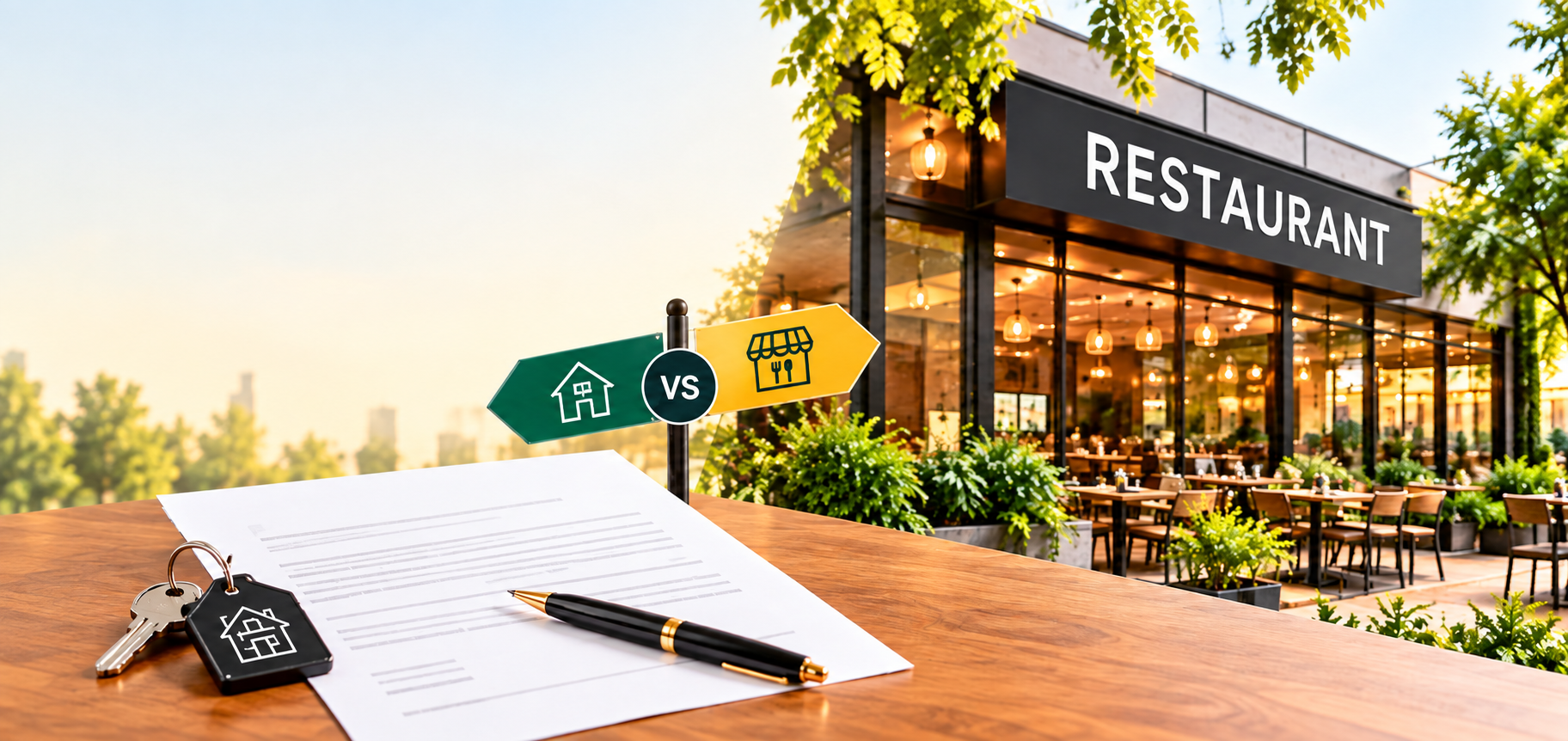
Planning to open a restaurant in India? It is important to understand that choosing the right property model is crucial. It is not just any choice. Instead, it is something that can determine your restaurant’s capital needs, growth, risk, and flexibility.
What factors does this choice depend upon? Well, it depends on various factors like concept, location, budget, tenure, and your expansion plans. And ideally, the property you choose must meet the demands of an F&B business.
In this blog, we’ll break it all down for the reader.
Restaurant Lease vs Buying Commercial Property: What’s the Difference?
Leasing means using a commercial property for an agreed period while paying rent and applicable charges. The restaurant does not own the premises.
Buying means purchasing the property and becoming its owner. This requires greater capital but gives the business control over the asset.
Leasing a Commercial Property for a Restaurant
Advantages of Leasing
Leasing can preserve capital.
- Lower upfront investment
- More funds for setup and operations
- Greater flexibility to relocate
- Easier entry for new or growing brands
- Access to premium locations without purchasing
Disadvantages of Leasing
The trade-off is a recurring expense.
- Recurring rent
- Rent escalation
- Lock-in and renewal considerations
- Dependence on landlord and lease terms
- No direct benefit from property appreciation
Buying Commercial Property for a Restaurant
Advantages of Buying
Buying can suit established businesses.
- Ownership of the property
- Potential appreciation
- Greater control over premises
- Reduced relocation risk
- Long-term business asset
Disadvantages of Buying
Ownership requires substantial capital.
- High initial investment
- Capital locked into real estate
- Stamp duty, registration and maintenance
- Relocation can be more difficult
- Ownership does not guarantee profitability
Restaurant Lease vs Buying Commercial Property: Key Comparison
Factor | Leasing | Buying |
Initial investment | Lower | Higher |
Monthly expense | Rent | Loan, maintenance, and property costs |
Flexibility | Higher | Lower |
Ownership | No | Yes |
Capital requirement | Lower | Higher |
Relocation | Easier | More difficult |
Long-term asset | No | Yes |
Property appreciation | No direct benefit | Potential benefit |
Best suited for | New or growing brands | Established businesses |
What Should Restaurant Owners Consider Before Choosing?
Here are some things that would-be restaurant owners need to assess:
- Available capital and working capital needs
- Tenure
- Location and footfall
- Restaurant format
- Expansion plans
- Revenue and occupancy costs
- Appreciation potential
- Lease terms and escalation clauses
- Technical suitability
For an F&B property, technical checks are critical. Review water and drainage, power load, exhaust and ventilation, accessibility, and local licensing requirements.
At Jaygee Hospitality, we highlight these factors during our property evaluation.
When Is Leasing Better for a Restaurant?
Leasing may suit the following:
- First-time restaurant owners
- New concepts testing a market
- Brands entering a new city
- Businesses planning rapid expansion
- Brands targeting premium locations without buying
- Businesses preserving capital for operations
In a nutshell, it preserves capital for growth.
When Is Buying Better for a Restaurant?
Buying may suit the following:
- Established restaurant brands
- Businesses planning to stay for many years
- Owners with sufficient surplus capital
- Businesses seeking long-term asset creation
- Locations where ownership offers strategic value
Compare expected restaurant returns with capital committed to property.
Lease vs Buy: Which Option Is Better for Your Restaurant?
For this, there is no universal answer. Leasing may be better when flexibility, lower upfront investment, and expansion matter most. Buying may suit businesses seeking stability, control, and potential asset creation.
Base the decision on both the restaurant business plan and the property’s investment potential. Neither low rent nor an attractive purchase price guarantees success.
How Can an F&B Real Estate Consultant Help?
At Jaygee Hospitality, we help restaurants, cafés, bars, lounges, and cloud kitchens identify suitable commercial spaces.
Our service and support cover location sourcing, property evaluation, negotiations, legal paperwork, and site handover.
An F&B real estate consultant in India can help:
- Identifying restaurant spaces
- Evaluating locations and properties
- Assessing F&B infrastructure
- Comparing leasing opportunities
- Supporting lease negotiations
- Assisting with documentation
- Finding locations for expansion
At Jaygee Hospitality, we also work as an F&B leasing consultant and restaurant expansion partner, evaluating visibility, accessibility, infrastructure, and business potential.
Final Verdict
Leasing offers flexibility and lower upfront investment, while buying provides ownership, control, and potential long-term asset value. Neither is automatically better for every restaurant.
Evaluate capital, location, tenure, expansion plans, and property potential before deciding. F&B real estate guidance can make the process more informed.
FAQs
Is it better to lease or buy a commercial property for a restaurant?
It depends on your capital, tenure, flexibility, location strategy, and long-term business goals.
What are the benefits of leasing a restaurant space in India?
Leasing needs less upfront capital and offers flexibility for expansion, relocation, and market testing.
What should I check before buying a commercial property for a restaurant?
Check location, permitted use, infrastructure, accessibility, operating costs, customer catchment, and investment potential.
Is buying commercial property a good investment for restaurant owners?
It can suit established businesses with capital, long-term plans, and confidence in the location.
How can an F&B real estate consultant help with restaurant property selection?
A consultant can source and evaluate properties, assess F&B suitability, compare options and support negotiations.