
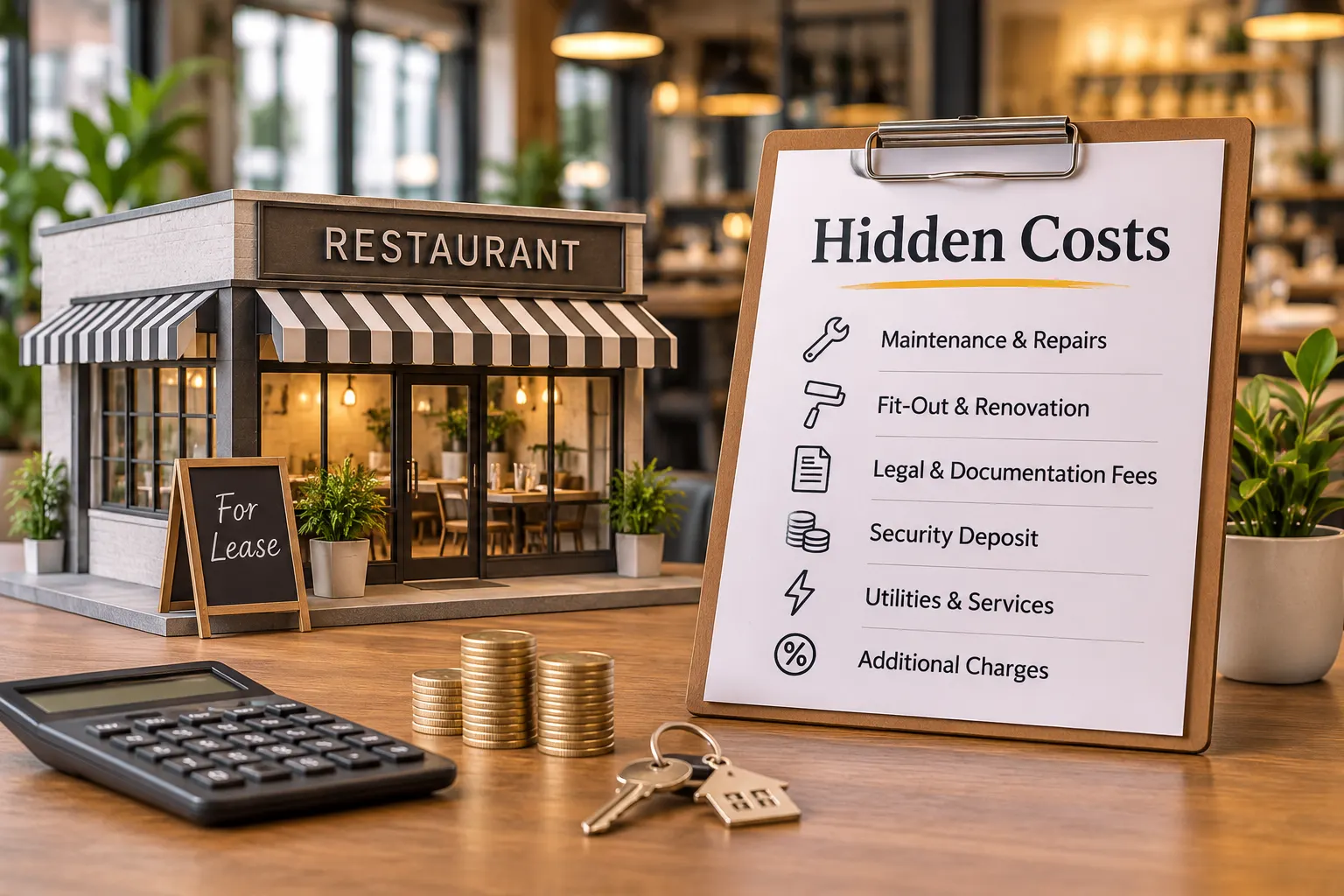
The rent for a particular listing is not exactly what a restaurant ends up paying. Once you add the deposits, maintenance charges and fit-out, a commercial food and beverage business actually costs far more than the suggested monthly figure.
Imagine a cafe owner having a budget of ₹1.5 lakh a month for a 1,200 sq ft unit. So, before the first coffee is sold, they could end up paying six months of rent as a deposit plus brokerage, and the cost of a kitchen. If you’re looking for a commercial property for a food & beverage business, Jaygee Hospitality can help you get the pricing right before you commit to a leasing agreement.
Why rent is not the only expense
The base rent for a commercial property pays for the space. Although the real occupancy cost covers everything, including one-time payments like the deposit, recurring ones like maintenance, and operating costs such as licence renewals and repair costs. Note that commercial rent also attracts 18% GST.
Most standalone restaurants bill food at 5% GST without input tax credit, so they can’t recover the tax on rent. On ₹1.5 lakh, that’s ₹27,000 a month, which most listings never mention.
Hidden costs to consider before leasing a commercial property
There is more than one hidden cost you need to know when leasing a commercial property for a food and beverage business.
Security deposit and advance rent
Landlords often ask for several months’ rent as a refundable deposit, sometimes with advance rent on top, and it usually earns no interest. Additionally, there’s the lock-in period, which means if you vacate the property early, you still owe the remaining rent.
Maintenance and CAM charges
In malls and commercial complexes, there’s a common area maintenance (CAM) charge that pays towards security, housekeeping and lifts. These are expenses that are billed monthly per square foot, rising each year. Before leasing, ask whether the CAM is worked out on a particular carpet area or the super built-up area.
Brokerage and legal fees
Brokerage for a commercial property is usually one or two months’ rent, and additional costs involve stamp duty and registration on the lease deed (varying by state) and a lawyer’s review fee.
Interior fit-out and renovation
Flooring, lighting, furniture and rewiring expenses can also add to the budget, with the kitchen being the biggest driver. So, always ask for a rent-free fit-out period to test the waters before committing.
Licensing and compliance
One of the basic licences you need to run a commercial F&B business is the FSSAI (₹100 a year for basic registration or ₹2,000 to ₹5,000 for a state licence). A fire NOC means you will need sprinklers or an extra exit. Adding to the list of expenses is a trade licence, local permit and liquor licence (where applicable).
Utilities and infrastructure
A full kitchen may need a higher sanctioned electrical load. Gas, water, exhaust ducting and internet each come with a deposit or installation charge.
Property-specific expenses F&B businesses often overlook
A former clothes shop has none of the plumbing or ventilation a kitchen needs, so you pay to build it. Common extras:
- Kitchen equipment, gas lines and extra power points
- Grease traps, drainage and a waste collection contract
- Signage, which may need landlord approval and a municipal permit
- Loading access and parking
- Structural work such as a new exhaust shaft or a reinforced floor for a walk-in cold room
Also ask, in writing, what you must restore when you leave. Reinstatement can cost as much as a small renovation.
How to calculate the total cost of leasing a commercial property
Here’s an illustration for a 1,200 sq ft cafe across different heads.
Cost | Type | Example |
|---|---|---|
Rent | Monthly | ₹1,50,000 |
GST on rent at 18% | Monthly | ₹27,000 |
CAM at ₹30 per sq ft | Monthly | ₹36,000 |
Security deposit (six months) | One-time, refundable | ₹9,00,000 |
Brokerage (one month) | One-time | ₹1,50,000 |
Fit-out and kitchen | One-time | ₹24,00,000 |
So, you can see, the monthly occupancy cost comes to ₹2,13,000, with 42% above the headline rent. The cafe would still need ₹34.5 lakh before opening. Then, you check for escalation at 5% a year and the rent reaches about ₹1.74 lakh by the fourth year.
How to avoid unexpected leasing costs
Here are a few tips to help you avoid unexpected leasing costs.
- Get the CAM basis, escalation rate, GST and deposit refund terms written into the lease
- Inspect power load, drainage and exhaust routes with your kitchen designer
- Confirm the building permits F&B use and can get a fire NOC
- Agree on who pays for repairs and what condition you hand the unit back in
- Have a lawyer review the agreement before you sign
The role of professional consultants in commercial property leasing
The job of a professional consultant for commercial businesses is to find the real costs early. Take into account questions like whether a particular unit can take a commercial kitchen, how CAM and escalation compare, and which clauses move repair costs. At Jaygee Hospitality, we support F&B businesses through commercial property consulting and turnkey leasing, along with legal and lease documentation support.
Plan beyond the rental cost
Before you sign, put the upfront costs and a year of occupancy costs into one sheet and test it against a slow month’s sales. If the numbers don’t work at full capacity, keep looking for a better deal.
Planning to lease a commercial property for your F&B business? Talk to Jaygee Hospitality about your shortlist. Contact us now!
FAQs
What are the additional costs of leasing a commercial property?
Besides the deposit, CAM, fit-out and licences, budget for fire and public liability insurance, GST on CAM charges and any property tax increase the lease passes on to you.
What are CAM charges in commercial property leasing?
CAM charges are your share of the cost for running shared areas. You need to start by asking for the last two years of CAM bills and see how fast they’ve risen.
Who pays for interior modifications in a leased restaurant?
The tenant usually pays for fit-out, while the landlord handles structural repairs and core building services. Some landlords will fund part of the work or offer rent-free months in exchange for a longer lock-in.
What should an F&B business check before signing a commercial lease?
Check whether the person signing owns the property or has authority to lease it, that the building has an occupancy certificate and that the previous tenant left no unpaid dues.
How can I calculate the total cost of leasing a commercial property?
To calculate the total cost of leasing a commercial property, divide your one-time costs by the months in your lock-in and add the result to your monthly costs.